



 Table of Contents
Planning Interval (PI) Planning has always been the heartbeat of SAFe®—the event that aligns teams, synchronizes delivery, and establishes a unified execution rhythm across the Agile Release Train (ART).
However, hybrid work models, globally distributed teams, and AI-powered tools have fundamentally changed how PI Planning must be executed. Organizations that still rely on traditional, room-centric approaches struggle with engagement, visibility, and predictability.
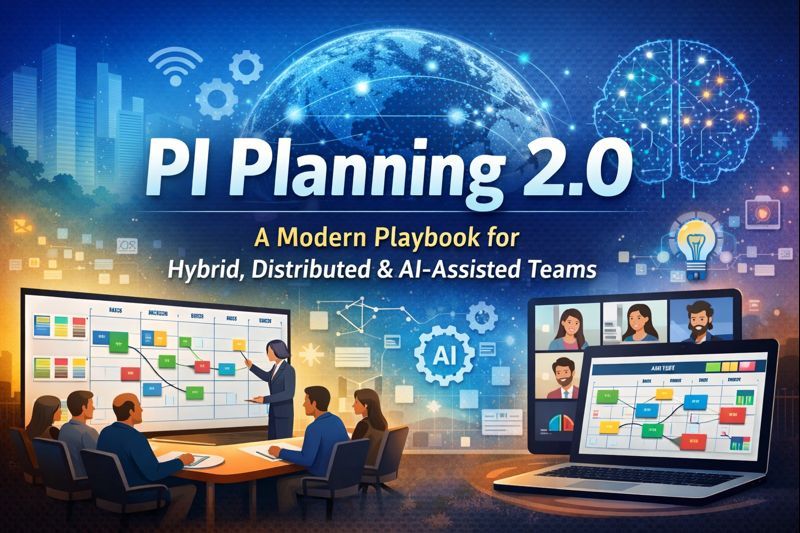
Welcome to PI Planning 2.0—a future-ready, hybrid-capable, and AI-assisted evolution of PI Planning designed for modern Agile enterprises.
The Evolution of PI Planning Since SAFe® 6.0
With SAFe® 6.0, PI Planning shifted from being a coordination ceremony to a flow-accelerating, value-focused event—a transformation that leaders learn deeply in the
? Leading SAFe® Certification Training.
Flow-Centric Planning
Modern PI Planning emphasizes:
- Flow of value over task utilization
- Flow metrics and predictability
- Flow-based roadmapping
- Real-time dependency visualization
This enables ARTs to reduce delays and improve delivery confidence.
Stronger Customer-Centricity
PI Planning is no longer just about committing to work—it is about aligning teams around customer outcomes and business value. Product Managers and Product Owners play a critical role here, a capability strengthened in advanced SAFe leadership roles.
Clearer Role Responsibilities
Clear accountability across RTEs, PMs, POs, and Architects has streamlined PI Planning.
Release Train Engineers, in particular, act as chief facilitators of flow, a responsibility covered in depth in the
? SAFe® Release Train Engineer (RTE) Certification.
Remote & Hybrid Enablement
SAFe® explicitly supports digital PI Planning using collaboration tools and structured facilitation patterns, enabling distributed ARTs to plan effectively across locations and time zones.
AI as a Planning Partner
AI now supports PI Planning by:
- Generating and refining user stories
- Suggesting WSJF prioritization
- Forecasting delivery risks
- Identifying cross-team dependencies
These capabilities are increasingly leveraged by experienced SPCs driving enterprise-wide transformations.
Top Challenges in Hybrid & Distributed PI Planning (and Solutions)
Challenge 1: Fragmented Collaboration
Remote participants often feel disconnected.
Solution
- Dedicated remote facilitator
- All planning on shared virtual boards
- Strong hybrid etiquette (no side conversations)
Challenge 2: Tool Overload
Too many tools reduce focus.
Solution
- One communication tool (Zoom / Teams)
- One planning board tool (Miro / Mural / FigJam)
- One execution tool (Jira / Azure DevOps)
Challenge 3: Time-Zone Constraints
Global ARTs struggle to collaborate live.
Solution
- 4–6 hour shared collaboration window
- Asynchronous pre-work
- Recorded leadership briefings
Challenge 4: Virtual Fatigue
Long sessions reduce engagement.
Solution
- Half-day planning blocks
- Energizers and micro-breaks
- AI-generated notes and summaries
Challenge 5: Dependency Blind Spots
Distributed teams miss dependencies.
Solution
- Real-time ART Planning Board
- AI-powered dependency detection
- Clear color-coded visualization
The Role of AI in PI Planning 2.0
AI brings precision, speed, and predictability to planning.
AI-Assisted Backlog Refinement
AI helps teams:
- Create structured user stories
- Suggest acceptance criteria
- Split oversized features
- Estimate relative complexity
AI-Driven WSJF Prioritization
AI analyzes historical delivery, customer feedback, market data, and team performance to propose WSJF scores—validated by teams during PI Planning.
AI-Supported Capacity & Risk Management
AI identifies:
- Velocity trends
- Capacity imbalances
- High-risk dependencies
- Historical bottlenecks
These insights significantly improve commitment reliability.
Designing an Effective Hybrid PI Planning Setup
Physical Setup
- U-shaped seating
- Dual large screens
- High-quality microphones
- Dedicated ART Planning Board display
Remote Team Setup
- Dual monitors
- HD camera
- Noise-canceling headset
- 40+ Mbps internet connection
Tooling Architecture
- Communication: Zoom / Microsoft Teams
- Planning Board: Miro / Mural / FigJam
- Execution: Jira / Azure DevOps
Facilitation Design
Before PI Planning
- Backlog refined
- AI-assisted WSJF completed
- Dependencies mapped
- ART Planning Board prepared
During PI Planning
- Structured breakouts
- Real-time dependency updates
- Leadership alignment
After PI Planning
- Sync commitments to Jira/Azure
- Publish PI Objectives
- Capture Inspect & Adapt inputs
PI Planning Checklist for 2025
Before Planning
? Backlog refined
? AI-assisted prioritization
? Capacity aligned
? Dependencies mapped
? ART Planning Board ready
During Planning
? Vision & roadmap shared
? Team breakouts
? ROAM risks
? Confidence vote
After Planning
? Plans synced
? PI Objectives published
? Continuous improvement actions logged
Conclusion
PI Planning has evolved into a digital-first, AI-enabled, and hybrid-friendly discipline.
Organizations that embrace PI Planning 2.0—supported by strong RTE facilitation, SPC guidance, and modern tooling—achieve higher:
- Predictability
- Transparency
- Flow of value
- Cross-team alignment
For organizations scaling SAFe® or modernizing enterprise agility, investing in experienced roles such as RTEs and SPCs is critical.
If you are building these capabilities internally, consider advanced certifications like:
PI Planning 2.0 isn’t the future—it’s the new standard.

view Count
2290