



 Table of Contents
1. Introduction
2. What Is Traditional Automation?
3. What Is Agentic AI Automation?
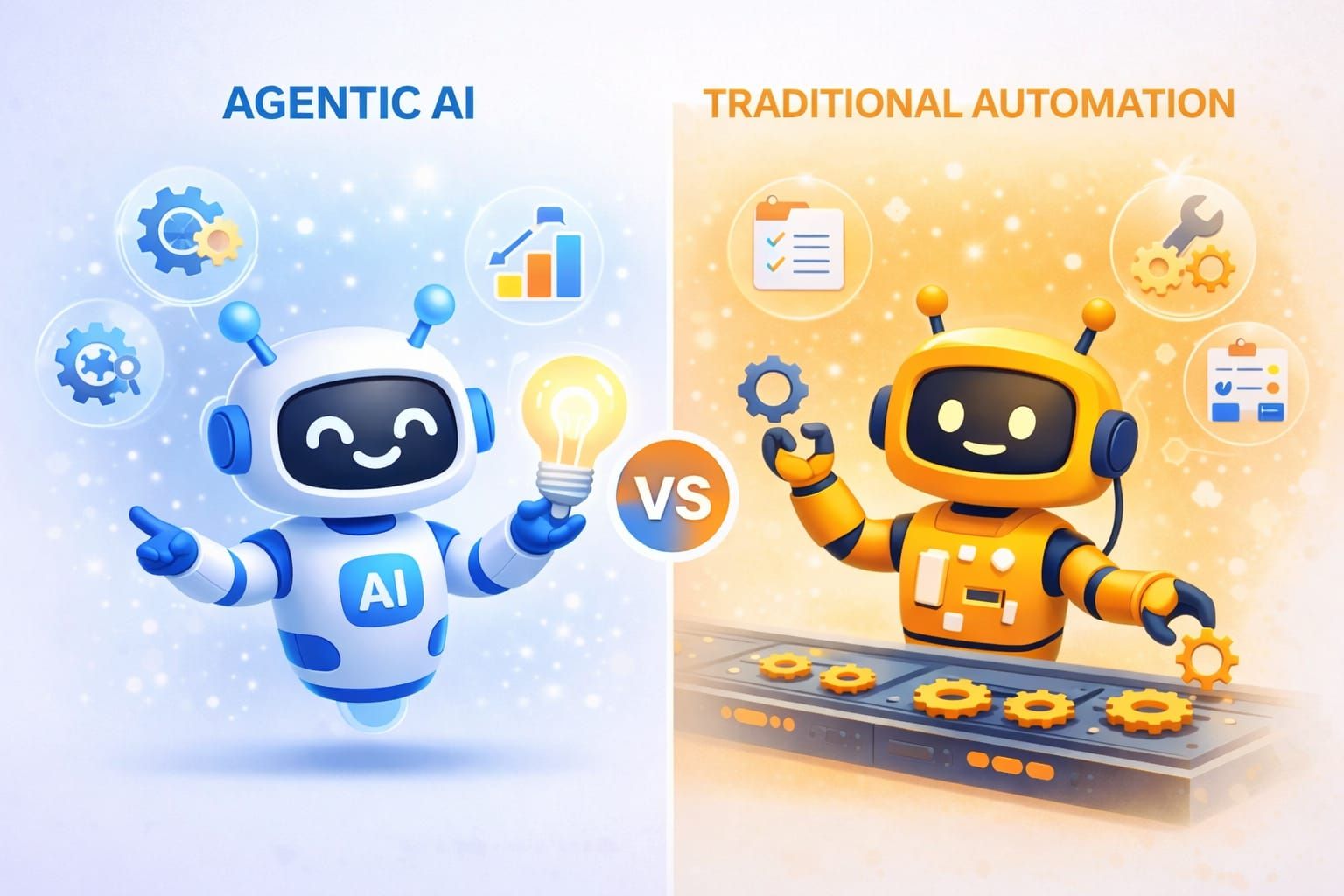
4. Key Differences Between Agentic AI and Traditional Automation
5. When Traditional Automation Works Best
6. When Agentic AI Automation Is the Better Choice
7. Real-World Business Scenarios
8. Choosing the Right Automation Strategy
9. Final Thoughts
As businesses accelerate their digital transformation efforts, automation has become a critical driver of efficiency and scalability. However, not all automation is the same. With the rise of autonomous AI systems, organisations are increasingly comparing agentic AI vs traditional automation to understand which approach delivers greater long-term value.
This guide explains the key differences between agentic AI automation and traditional automation, how each works, and which approach is best suited for modern business environments.
What Is Traditional Automation?
Traditional automation relies on predefined rules, scripts, or workflows to execute repetitive tasks. These systems follow exact instructions and perform consistently as long as conditions remain unchanged.
Examples of traditional automation include rule-based workflows, robotic process automation (RPA), scheduled scripts, and predefined business rules. While effective for predictable tasks, traditional automation struggles when decision-making or adaptability is required.
What Is Agentic AI Automation?
Agentic AI automation introduces autonomous AI agents that can reason, plan, and act independently to achieve specific goals.
Unlike traditional automation, agentic AI systems understand intent, adapt to changing inputs, make decisions without constant human intervention, and learn from outcomes over time. This enables automation of complex, dynamic workflows rather than just repetitive tasks.
Key Differences Between Agentic AI and Traditional Automation
Traditional automation executes predefined instructions and cannot adapt beyond programmed rules. Agentic AI automation evaluates context, chooses actions dynamically, and optimises outcomes based on real-time information.
Agentic AI also scales more effectively, handles exceptions intelligently, and reduces reliance on manual oversight compared to traditional automation approaches.
When Traditional Automation Works Best
Traditional automation is effective when processes are repetitive, predictable, and rule-based. It works well for tasks with structured data, minimal decision-making, and stable workflows.
When Agentic AI Automation Is the Better Choice
Agentic AI automation is ideal for workflows involving frequent changes, multiple systems, contextual decision-making, and human judgement. It enables end-to-end process ownership rather than simple task execution.
Real-World Business Scenarios
For example, traditional automation may route support tickets based on fixed rules, while agentic AI can analyse intent, prioritise urgency, suggest solutions, and resolve issues autonomously.
This highlights how agentic AI transforms automation into intelligent decision-making systems.
Choosing the Right Automation Strategy
Most modern organisations benefit from a hybrid approach, combining traditional automation for stable processes and agentic AI automation for complex, adaptive workflows.
Final Thoughts
The comparison between agentic AI vs traditional automation is not about replacing one with the other. It is about selecting the right approach based on business needs, complexity, and growth goals.

view Count
2383