



 Table of Contents
1. Introduction
2. What Is Workflow Automation?
3. What Is Generative AI?
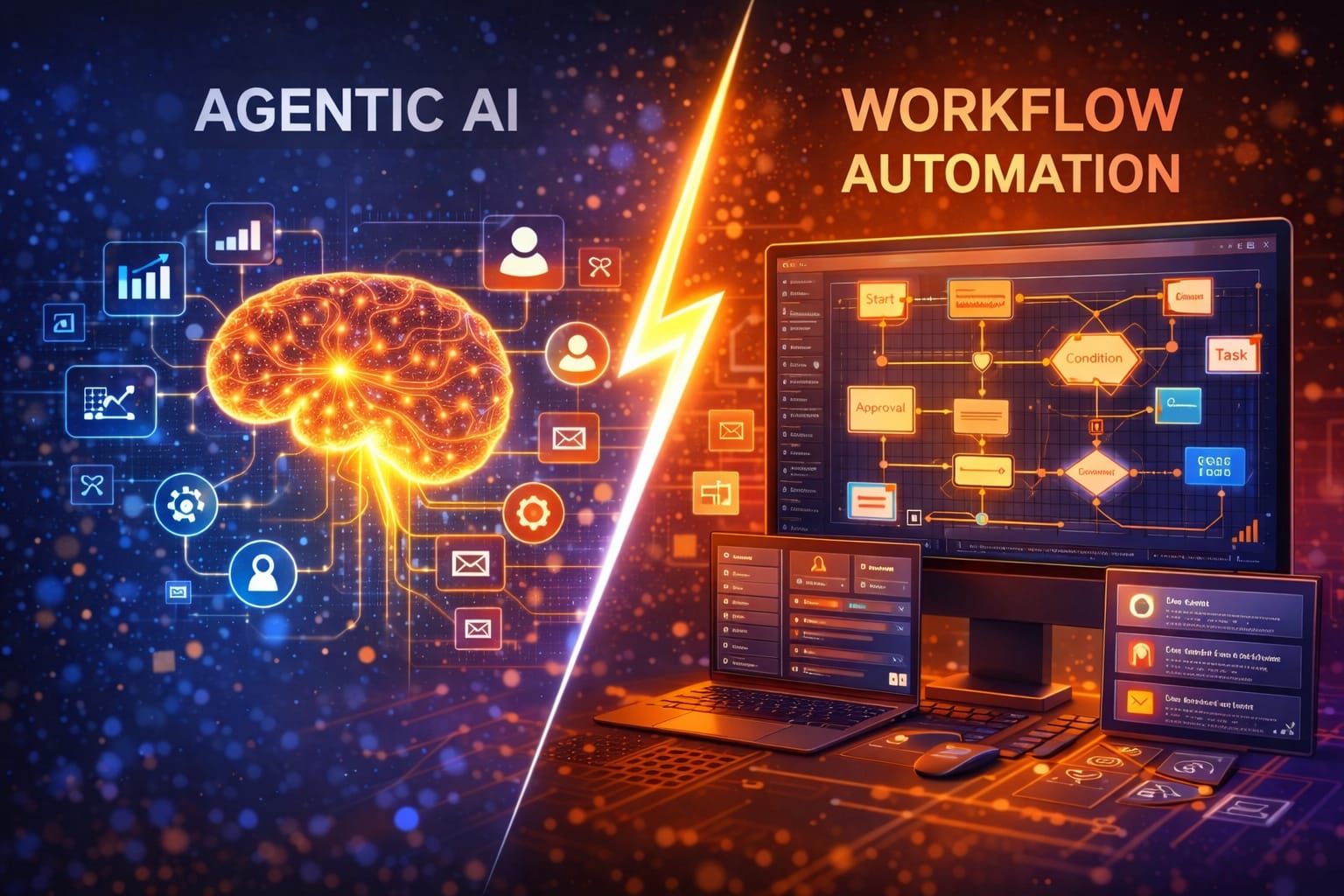
4. Key Differences Between Generative AI and Workflow Automation
5. When Should You Use Workflow Automation?
6. When Should You Use Generative AI?
7. Generative AI vs Workflow Automation: Which One Is Right for Your Business?
8. Combining Generative AI and Workflow Automation
9. How Advance Agility Helps Organisations Implement AI Automation
10. Final Thoughts
Introduction
Automation has become a critical driver of efficiency, scalability, and cost optimisation for modern organisations. As businesses explore automation strategies, two terms frequently appear: generative AI and workflow automation.
While both aim to reduce manual effort and improve productivity, they operate in fundamentally different ways.
Understanding the difference between generative AI and workflow automation is essential for organisations planning their automation roadmap and long-term digital strategy.
This guide explains how each approach works, where they are best applied, and how businesses can choose the right solution based on their needs.
What Is Workflow Automation?
Workflow automation refers to the use of predefined rules and logic to automate repetitive, structured business processes. These workflows follow a fixed sequence of steps and execute actions when specific conditions are met.
Workflow automation is highly effective when processes are predictable, repeatable, and clearly defined.
Common workflow automation examples include:
-
Automatically routing invoices for approval
-
Triggering emails when a form is submitted
-
Updating CRM records after a sales activity
-
Scheduling reports at fixed intervals
Workflow automation reduces errors, speeds up operations, and frees teams from routine manual tasks.
What Is Generative AI?
Generative AI uses advanced machine learning models to generate content, responses, or decisions dynamically based on context and data. Unlike workflow automation, generative AI does not rely on fixed rules.
Generative AI can interpret unstructured information, understand intent, and adapt outputs in real time.
Common generative AI use cases include:
-
AI-powered customer support chatbots
-
Automated content generation and summarisation
-
Intelligent document analysis
-
Context-aware recommendations
Generative AI is best suited for scenarios where flexibility, interpretation, and human-like reasoning are required.
Key Differences Between Generative AI and Workflow Automation
|
Criteria |
Workflow Automation |
Generative AI |
|---|---|---|
|
Logic |
Rule-based |
Context-driven |
|
Flexibility |
Low |
High |
|
Decision-making |
Predefined |
Adaptive |
|
Best suited for |
Repetitive processes |
Complex or ambiguous tasks |
|
Learning ability |
None |
Learns from data |
|
Output |
Predictable |
Dynamic |
When Should You Use Workflow Automation?
Workflow automation is ideal when:
-
Processes follow clear, consistent rules
-
Steps rarely change
-
Compliance and consistency are critical
-
Decisions do not require interpretation
Example:
Automating employee onboarding checklists or payroll approvals.
When Should You Use Generative AI?
Generative AI is most effective when:
-
Inputs vary widely
-
Decisions require interpretation or judgement
-
Human-like interaction is expected
-
Data is largely unstructured
Example:
An AI assistant handling diverse customer support queries.
Generative AI vs Workflow Automation: Which One Is Right for Your Business?
There is no one-size-fits-all answer.
The right choice depends on:
-
Process complexity
-
Volume of variation
-
Business objectives
-
Risk tolerance
In many real-world scenarios, organisations benefit most from combining both approaches.
Combining Generative AI and Workflow Automation
Modern automation strategies increasingly rely on hybrid models, where:
-
Workflow automation manages predictable, structured steps
-
Generative AI handles interpretation, reasoning, and exceptions
Example hybrid flow:
-
A workflow automation detects a customer request
-
Generative AI interprets intent and generates a response
-
Workflow automation executes the next action
This combination delivers scalable and intelligent automation.
How Advance Agility Helps Organisations Implement AI Automation
Advance Agility helps organisations:
-
Assess automation readiness
-
Identify high-impact automation use cases
-
Design hybrid AI and workflow automation strategies
-
Implement scalable, secure automation solutions
Whether your organisation requires rule-based automation, generative AI, or a combination of both, our experts ensure your automation initiatives align with business outcomes.
Final Thoughts
Workflow automation and generative AI are not competing technologies — they are complementary.
-
Workflow automation delivers speed, consistency, and control
-
Generative AI enables adaptability, intelligence, and insight
Understanding how and when to use each approach is key to building a future-ready automation strategy.

view Count
1360