




 Table of Contents
- Introduction: My Journey to the Pega Business Architect Certification
- What is the Pega Certified Business Architect (CPBA) Certification?
- CPBA Exam Structure and Format
- Number of Questions
- Exam Duration
- Passing Score
- Types of Questions (Scenario-Based, Multiple Choice, Drag & Drop)
- CPBA Exam Topic Weightage Explained
- Case Management
- Application Development
- Data and Integration
- User Experience
- Pega Express Methodology
- Reporting and Security
- My Step-by-Step CPBA Study Plan
- Step 1: Start with the Official Pega Exam Blueprint
- Step 2: Complete Pega Academy Business Architect Missions
- Step 3: Build Small Applications in App Studio
- Step 4: Create Your Own Pega Terminology Glossary
- Step 5: Study Based on Exam Topic Weightage
- Step 6: Practice with Timed Mock Exams
- Step 7: Final Week Preparation Strategy
- Real Challenges While Preparing for the CPBA Exam
- Scenario Questions That Look Similar
- Managing Time During the Exam
- Outdated Study Material and Version Confusion
- Too Much Theory vs Practical Practice
- Tricky Wording in Questions
- Key Topics You Must Master for the CPBA Exam
- Case Lifecycle and Case Management
- Data Objects, Data Pages, and Integration
- Pega Express and Microjourneys
- Application Development in App Studio
- Reporting and Dashboards
- Exam Strategy: How I Managed Time During the Test
- Best Preparation Tips for Passing the Pega CPBA Certification
- Final Thoughts: Why the CPBA Exam Tests Thinking, Not Memory
How I Cleared the Pega Business Architect Certification: A Realistic Guide
When I decided to take the Pega Certified Business Architect (CPBA) exam, it wasn’t because I suddenly wanted to become an architect. The certification was required for delivering a Pega project I was involved in.
I already had a basic understanding of Pega and the platform, but I had never worked as a Business Architect before.
Very quickly, I realised something important.
Passing this exam is not about memorising terms.
It is about learning to think like a Pega Business Architect.
In this blog, I’ll share exactly how I prepared, what the exam feels like, and the real challenges I faced during preparation.
Understanding the Exam: What You’re Really Signing Up For
Before opening any course or study material, I started with the official Pega Academy exam page.
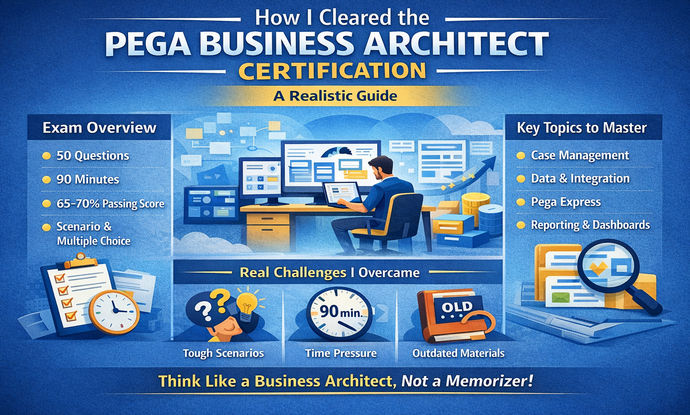
This gave me four key facts about the exam:
- Around 50 questions
- 90 minutes total exam time
- Passing score roughly 65–70% depending on the version
- Question types include scenario-based, multiple choice, and sometimes drag-and-drop
More importantly, the exam blueprint shows topic weightage, which heavily influenced how I studied.
Topic Weightage Overview
- Case Management: Largest portion (around 30–38%)
- Application Development: Around 20–25%
- Data & Integration
- User Experience
- Pega Express
- Reporting
- Security (small portion)
Once I saw this breakdown, it became very clear:
If I didn’t master Case Management and Application Development, guessing answers wouldn’t help me pass the exam.
My Step-by-Step Study Plan (What Actually Worked)
Step 1: Start With the Official Blueprint
The first thing I did was download and save the official exam blueprint.
I treated it like a project backlog.
Every topic I studied had to map to one of the blueprint sections. If something didn’t appear there, I didn’t waste time studying it.
This helped me stay focused and avoid information overload.
Step 2: Complete Pega Academy’s Business Architect and App Studio Courses
Instead of watching random YouTube videos, I focused mainly on Pega Academy’s Business Architect and App Studio missions.
The most important part for me was:
- Completing every challenge exercise
- Reading scenario descriptions carefully
- Practising within the platform rather than just watching lessons
Many exam questions follow a similar scenario-based format, so these exercises helped me understand how Pega expects a Business Architect to think.
They also forced me to work with concepts like:
- Case types
- Stages and steps
- Data objects
- Reports
- User interface configuration
Step 3: Build 1–2 Small Apps in App Studio
This step made the biggest difference in my preparation.
Instead of only studying theory, I built small sample applications in App Studio.
For example:
- An IT Helpdesk application
- A Loan Request workflow
Using App Studio, I practiced:
- Creating case types with stages and steps
- Designing alternate paths
- Creating data objects and relationships
- Configuring basic SLAs and routing rules
- Building reports and dashboards
After doing this, exam questions about case lifecycle or data behaviour suddenly felt much easier because they described things I had already built myself.
Step 4: Create a Personal Pega Glossary
The CPBA exam includes many similar-sounding terms with very specific meanings.
To avoid confusion, I created a small glossary with terms such as:
- Case vs Case Type vs Work Object
- Data Object vs Data Page
- Data Transform
- Flow Action vs Assignment vs Step
- SLA types
- Routing options
- Decision tables
- When rules
Each night I spent about 5–10 minutes reviewing this glossary.
By the time the exam arrived, the terminology felt natural.
Step 5: Study Based on Topic Weightage
One mistake many candidates make is studying topics they like the most, rather than the ones that carry the most weight.
I followed the official blueprint percentages carefully.
My study focus looked like this:
Deep focus
- Case Management
- Application Development
Moderate focus
- Data & Integration
- User Experience
- Pega Express
Quick but clear coverage
- Reporting
- Security
This ensured I invested time where the maximum marks were available.
Step 6: Take Timed Mock Tests
Practice exams played a crucial role in my preparation.
My approach was simple:
- Simulate real exam conditions
- 50–60 questions
- 90 minutes
- No distractions
In many cases, I spent more time analysing wrong answers than taking the test itself.
Over time I noticed patterns. I was consistently missing questions related to case routing behaviour and integration scenarios, so I focused more on those areas.
Step 7: Final Week – Focus on Strategy
During the last week before the exam, I stopped trying to learn new material.
Instead, I focused on improving my exam strategy.
I practised:
- Reading long scenario questions carefully
- Eliminating obviously incorrect answers first
- Selecting the most “Pega best practice” option
Usually the correct answer is the one that:
- Uses out-of-the-box features
- Avoids unnecessary customisation
- Follows Pega Express methodology
The Real Challenges (And How I Dealt With Them)
1. Scenario Questions Where Every Option Looks Correct
This was the hardest challenge.
Many answers appear logical, but Pega expects you to select the one that follows best practices.
The key mindset was:
- Prefer configuration over customisation
- Reuse existing capabilities
- Think in terms of Microjourneys and case design
Reading about Pega Express best practices helped a lot.
2. Time Pressure
90 minutes sounds comfortable, but the time goes quickly.
My exam strategy was:
- Spend no more than 90 seconds per question initially
- Flag difficult questions
- Return to them later
I used the final 10–15 minutes to review flagged questions.
This helped reduce stress near the end of the exam.
3. Outdated Study Material
One challenge I faced was finding outdated resources online.
Some blogs and exam dumps didn’t match the current exam structure.
To avoid confusion, I relied mainly on:
- Pega Academy
- The official exam blueprint
External blogs were useful only for additional explanations.
4. Too Much Theory, Not Enough Practice
At one point, I realised I had consumed a lot of theory but had not built enough in App Studio.
When I tried practice questions, it was hard to visualise how certain configurations worked.
So I changed my approach.
For every concept I studied, I asked myself:
“Can I demonstrate this in App Studio?”
If not, I created a small example until I understood it.
This made the exam feel much more practical.
5. Tricky Question Wording
Some questions contain words like:
- Best
- First
- Most efficient
These small words can completely change the correct answer.
To avoid mistakes, I trained myself to re-read the final sentence of the question carefully before selecting an option.
Key Topics I Would Never Skip
If I had to prepare for the exam again, these would be my top priorities.
Case Management
- Stages
- Steps
- Alternate stages
- SLAs
- Routing
- Resolution conditions
Data and Integration
- Data objects
- Data pages
- Data transforms
- When to integrate vs store data
Pega Express
- Microjourneys
- Minimum Lovable Product
- DCO workshops
- Agile delivery in Pega projects
Application Development in App Studio
- Business Architect vs System Architect roles
- Reuse strategies
- Rules, rulesets, and classes at a conceptual level
Reporting and Dashboards
- Report definitions
- Filters and columns
- Displaying reports in dashboards or portals
Final Thoughts: It’s a Thinking Exam, Not a Memory Test
Looking back, the Pega Business Architect certification feels less like a traditional exam and more like a mindset test.
If you:
- Follow the official exam blueprint
- Build real mini applications in App Studio
- Practise scenario-based questions under time pressure
you won’t just pass the exam — you’ll start thinking like a real Pega Business Architect.
For me, this certification improved how I design case lifecycles, data models, and processes in Pega projects.
It also strengthened my ability to connect stakeholder goals with Pega capabilities, instead of jumping directly to random technical solutions.
And that’s the real value of this certification.
Hopefully, this guide helps you on your CPBA journey too.

view Count
802